

On Wednesday 1 May we welcomed back John Humphrey FRPS for another talk, this time on “Creative and Experimental Photography”.
His mission was to help us recover our creative powers.
John has been taking pictures for many years. His photographs cover a wide range of subjects. But he specialises in close-up, floral, and abstract studies using a combination of digital and film images.
His photographs have been shown in many exhibitions, including the London Salon of Photography and the International Print and Projected Exhibitions of the Royal Photographic Society. And he also runs a range of photographic events, including RPS workshops on Macro and Art Photography and Creative Techniques in Photoshop, and has published several photographic books.
John previously visited us in 2016 to instruct us in “Creative Techniques in Photoshop”.
John presumed that, as enthusiastic photographers, we all wanted to be creative. But he recognised this could be a struggle.
He told us that a NASA Creativity Test, devised by research scientist George Land, had shown that our original unbridled creativity as a child diminishes dramatically as we age. This has been attributed to the developing dominance of the logical and analytical left side of the brain, over the intuitive and creative right side of the brain, as people age and mature. (“Every child is an artist. The problem is how to remain an artist once we grow up.” Pablo Picasso.)
John’s aim was therefore to help us find new routes to creativity. And, to that end, he offered us a wealth of ideas to explore that he hoped would prove helpful.
Using his own splendid images for illustration, John showed us how imaginative pictures could be created through all sorts of experimentation.
These included the following.
- Exploring Everyday Objects through close-ups. John showed us some carefully constructed images of an electrical plug, cutlery, paper scraps, glasses of water (distorting striped backgrounds), and flowers (including decaying ones). These were nearly all “straight” photography – ie, not involving significant post-processing. But they were fascinating creative images rather than “record” shots.
- Playing with Displacement Mapping – where the pixels of one image are repositioned by the pixels of another, “textured” or shaped, “displacement map” image. The first image takes on the texture or shape of the displacement map. (Look online for the required Photoshop etc jiggery-pokery.) John showed us garden photos displaced/distorted by tree bark textures as well as some cityscapes. The more extreme the displacement, the more abstract the results.
- Trying Shrinking a part of an image and replacing it in the image. John showed us examples where he had copied a receding series of arches, reduced them in size and used these reduced arches to extend the original series of arches. Similarly, he had used this “continuous recession” technique to increase the height of spiral staircases. John also introduced us to the “Droste effect” (named after a packaging design used in 1904 for Droste cocoa powder) where a picture repeatedly appears within itself.
- Using Double Exposures which can be created either in camera or post-processing. In Photoshop you can simply stack several similar images in layers and adjust their opacity as required. John showed us images in which he had created a very busy New York street scene and how, by combining different views of a small bouquet of flowers, he had produced a much larger bouquet of flowers. Variations could be introduced by flipping images (horizontally or vertically) and/or stretching layers.
- Experimenting with Movement and Blurring (again, either in camera of post-processing). Slow shutter speeds can be used to capture movement and John showed us semi-abstract images of flamingos, feeding koi carp, and some wind-ruffled rosebay willowherb. Intentional Camera Movement (ICM) can create movement in camera and a similar effect can be achieved with a Vaseline-smeared filter. Or directional blurring can be introduced in Photoshop. John showed us some woodland scenes (ICM and Vaseline), buildings and city scenes (Linear Blur, plus Find Edges), dried tulips (Path Blur), and Lisianthus (Radial Blur).
- Messing about with Colour through toning, split-toning (eg, blue/yellow), spot-toning, or colour-popping or some combination of these – especially if handled subtly. John showed us a variety of examples, including a fascinating picture of a “slinky” which had started as (virtually) black and white and then he had copied and flipped it, applied the Polar Co-ordinates filter in Photoshop, before applying some colour treatments.
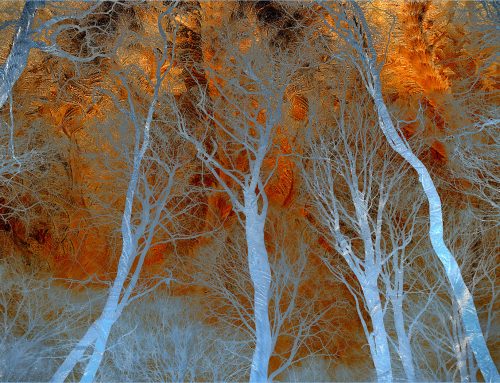
- Making Negatives in Photoshop. Inverting a black and white image turns the white pixels black and vice versa. When a colour image is flipped, every colour is flipped to its opposite on the colour wheel. John showed us some lovely geranium seedheads and flower studies that had been inverted.
- Indulging in some Abstraction. The Tate Gallery definition of abstract art is “art that does not attempt to represent an accurate depiction of a visual reality but instead uses shapes, colours, forms and gestural marks to achieve its effect”. John showed us a variety of his abstract images ranging from close-ups of soap bubbles and oil mixed with water (with colourful backgrounds) to water droplets on CDs and water ripples.
In addition, John likes to bring pictures together in panels or collections. Among other images he showed us his collection of 50 images of doors.
This was a hugely enjoyable talk for both the thought-provoking content and the eloquence of the speaker. Plus, of course, John’s and extensive portfolio of splendid images. There was much here to inspire members and John encouraged everyone to explore their creativity.
“Ignore left-brain rules. What matters is the picture!”
More of John’s work can be found in the gallery on his website at http://www.johnhumphrey.co.uk, together with details of his published books.





Leave A Comment