
On Wednesday 23 October we were delighted to welcome Lloyd Moore to the club with his talk on “The Art of Story Telling – The Extra Element”.
Lloyd Moore DPAGB BPE5* EFIAP has visited us as a judge on numerous occasions. He is a part time professional photographer (with many years of experience) and a member and Past-President of the Watford Camera Club. He has achieved many distinctions and awards, runs photographic workshops, and is a very experienced CACC judge.
Lloyd is therefore both a photographer who has entered many competitions and a judge who has judge many competitions. So he understands the emotional attachment we have to our own images and the disappointment we feel when they do not do as well as we might have expected. His talk is about camera club competitions and he suggested an alternative title might be “What the judges really think”!
Judges of camera club competitions often have to consider how to distinguish between, for example, two (or more!) technically competent “birds on sticks”. To be successful in competitions, therefore, the photographer needs to offer something original, different, unique, or surprising. Judges need to see some obvious author input that provides a differentiating “extra element”.
An image does not always have to tell a story. But it does need to be more than a record shot and a mere reproduction of a thing or scene. As many competition entries are quite “samey”, Lloyd’s talk aimed to encourage photographers to distinguish their work from other very similar images.
Accordingly, Lloyd suggested ways in which we might create images that have narrative, or some other distinctive element, to elevate our “nice” images into images that have atmosphere or meaning.
He posed the question, “what makes an image interesting?” One answer might be “when something is happening”. So creating or suggesting a story adds something extra, different, and/or emotional.
But, while storytelling, could be a large part of the “extra element”, there are other inputs which can provide a further ingredient to create something different.
Technical competence is just one component which is expected, indeed demanded, but photography is an art as well as a science and a successful image will generally have one or more of the following attributes:
Impact – Does it make you sit up? Will the image stay in the memory?
Originality – Is it unique? Judges get bored with seeing the same stuff countless times.
Narrative – Is there nuance from which an interpretation can be drawn?
Mood – How does the image make you feel?
Atmosphere – Presenting in a way that projects an interesting sense of place and time. Eg, early morning mist.
Emotion – Is there a sense of joy, desperation, pathos, excitement, resignation, etc?
A decisive moment – A unique moment in time captured in a single frame.
Author input – What has the author done that does more than merely represent the scene?
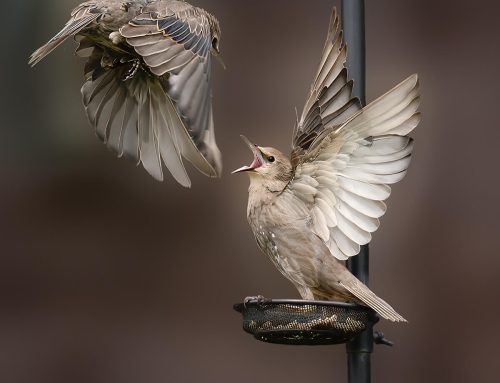
Behaviour – Eg, birds squabbling. Prevalent in wildlife photography but applies equally to other genres.
Movement – Does the image appear static when movement needs to be represented?
Images that lack any of the above are often viewed as technically sound but soulless; clinical yet boring.
Using his award-winning images as examples, and showing us the “before and after”, Lloyd explained the thoughts that went into capturing them and what he had done to prepare them for competitions. He gave us a variety of ideas to consider.
Playing with light (including in post-processing) can emphasise the interesting parts of an image. In addition to suggesting a narrative, this can create an interesting atmosphere or a mood.
Using the right medium helps – and dark images tend to do better as projected images while light/bright images generally do better as prints.
When considering pictures of animals (including pets) a judge might consider such matters as – is the image easily repeatable, how is the animal feeling, is behaviour displayed, is their movement/dynamism, is there a story? The photographer therefore should also consider such matters.
In street or action/sport photography it is important to “capture the moment”. This might be the moment of celebration as the football hits the back of the net for a goal or the moment a hurdler falls.
Composites can be used to create imaginative or even surreal – and eye-catching – images. (Just make sure to match colours, light, shadows, etc.)
Lloyd also encouraged us to be original, to “think outside the box”, and not be afraid to break the rules (and “then do it big time”).
Lloyd is an engaging and entertaining speaker. And all his suggestions were wonderfully illustrated by his “before and after” examples. His dual perspective as both photographer and judge brought an informative perspective to this instructive presentation. Now we just need to “get inspired”!




Leave a Reply